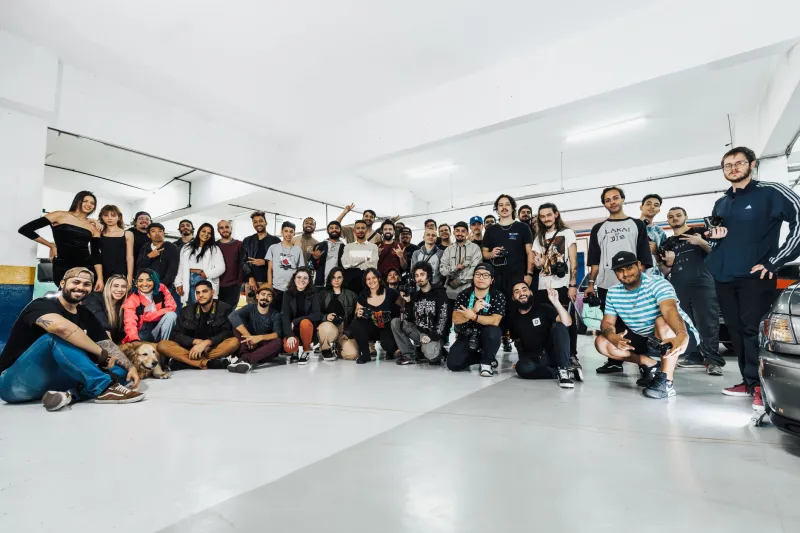
One of Us Is Taking Off: How Collectives Handle It When a Member's Star Starts Rising

Let's be honest for a second. Nobody puts it in the welcome packet when you join a collective. Nobody covers it in the first meeting or the mission statement or the shared Google Doc with all the bylaws. But eventually — if your collective sticks together long enough — it happens.
One person's work gets really good. Like, noticeably, undeniably, gallery-calling-them-directly good.
And suddenly the vibe in the room shifts in ways that are hard to name but impossible to miss.
The Thing Nobody Wants to Admit Out Loud
Skill disparity exists in every collective. Always has. The myth of the perfectly equal creative partnership is just that — a myth. People come in with different training, different years of practice, different access to mentorship, and wildly different amounts of time they can actually dedicate to making work. That's not a flaw in the collective model. That's just humans being humans.
But there's a particular kind of tension that surfaces when the gap stops being theoretical and starts being visible. When one member's piece gets picked up by a regional publication. When they land a residency the whole group applied to. When strangers at the opening are standing in front of their work for twenty minutes and breezing past everyone else's.
For the member whose star is rising, there's often guilt mixed in with the excitement. They didn't plan to pull ahead. They love these people. They don't want anyone to feel left behind.
For everyone else, it can trigger something that feels uncomfortably close to envy — even among people who genuinely care about each other and want good things for their collaborators. That combination of pride and sting is real, and pretending it isn't doesn't make it go away. It just makes it fester.
What Actually Breaks Collectives Apart (Hint: It's Not the Success)
Here's the thing that collectives who've navigated this well will tell you: the success itself rarely destroys a group. What breaks things apart is the silence around it.
When a member starts getting more opportunities and nobody acknowledges what's happening, the collective enters this weird collective fiction where everyone's pretending things are still equal when they clearly aren't. That fiction is exhausting to maintain. It breeds resentment on all sides — the rising member starts feeling like they can't share good news, and everyone else starts processing their complicated feelings in private instead of together.
Groups that handle this well tend to name it early and name it directly. Not in a dramatic confrontation kind of way, but in a "hey, let's actually talk about what's going on" kind of way. That takes a certain amount of bravery and a whole lot of psychological safety — which, if you've built it, is genuinely one of the most valuable things a collective can have.
Reframing the Win
One of the most powerful moves a collective can make is to consciously reframe individual success as collective proof of concept.
Think about it this way: if someone came up through your shared studio, got feedback from your group crits, was pushed by your collaborative projects, and is now getting serious recognition — that's not just their win. That's evidence that what you're building together actually works. Your collective is producing artists whose work gets seen. That's the whole point.
Some groups make this reframing explicit. They celebrate member milestones as group milestones. They talk openly about how a rising member's visibility can open doors for the whole collective — opportunities to collaborate, exhibition invitations, connections to curators and organizers who might not have found them otherwise.
This isn't just spin. It's genuinely true, and saying it out loud changes the emotional math.
Practical Things That Actually Help
Beyond the mindset shift, there are real structural things collectives can do to make skill disparity less corrosive.
Create mentorship pathways that flow inward. The member who's leveling up fast has skills and knowledge that could directly benefit everyone else. Formalizing that exchange — even informally, through structured feedback sessions or skill-share workshops — turns the gap into a resource instead of a wound.
Separate individual ambitions from collective goals. Healthy collectives get clear about what they're building together versus what each member is building for themselves. These don't have to conflict. But if the collective's identity is too tightly fused with everyone being at the same level, individual growth will always feel like a threat.
Check in more, not less. When things get awkward, the instinct is often to back off and give people space. But unspoken tension doesn't resolve itself — it just calcifies. Regular honest check-ins, even short ones, keep the relationship current and give people a place to say the uncomfortable things before they become bigger problems.
Celebrate out loud. This sounds simple but it matters enormously. When a member gets a win, make noise about it as a group. Post it, share it, show up to their opening. Public celebration signals to everyone — including the person receiving it — that growth is welcomed here, not resented.
The Harder Question
Sometimes, though, the conversation goes deeper than managing feelings. Sometimes a member's trajectory genuinely diverges from where the collective is headed. They're getting offers that require more time, more independence, more distance from the group's shared work. And everyone has to reckon with what that means.
This doesn't have to mean a breakup. Plenty of collectives have evolved to accommodate members at different stages — some contributing heavily, others in a more peripheral orbit while they pursue individual opportunities. The key is making those arrangements explicit and consensual rather than letting them happen by default and pretending nothing has changed.
Other times, an honest conversation surfaces the fact that someone has simply outgrown the collective's current structure — and that's okay too. A graceful exit, handled with care and real acknowledgment of what was built together, is a thousand times healthier than a slow, resentful fade.
Growth Is the Point
At the end of the day, collectives exist to make artists better — to create the conditions where people push each other, learn from each other, and make work they couldn't have made alone. When that actually happens, when someone's craft genuinely takes a leap, that's not a crisis. That's the whole thing working.
The collectives that last are the ones that can hold individual growth and shared identity at the same time. They're the ones that can say you're getting really good without it meaning and that makes us nervous.
That's a hard thing to build. But it's worth every uncomfortable conversation it takes to get there.