What Happens When a Poet Walks Into a Recording Session
Photo: Luigi Novi, CC BY 3.0, via Wikimedia Commons
It sounds like the setup to a joke, right? A poet, a filmmaker, and a musician walk into a bar. But honestly, some version of that scenario is where a lot of the most interesting creative work is coming from these days.
We spend a lot of time thinking about collaboration here at Flat Bay Collective — it's kind of the whole point. But there's a particular kind of collaboration that doesn't get talked about enough: the cross-discipline kind. The kind where nobody is working in their comfort zone, where the poet doesn't quite understand why the musician keeps talking about "texture," and where the filmmaker is trying to explain something about negative space that the poet finds either profound or completely ridiculous depending on the day.
That friction? It's actually the good stuff.
Why Single-Medium Silos Hold Us Back
Here's a thing that happens when you work exclusively within your own discipline: you develop a very sophisticated internal language that makes total sense to everyone who already agrees with you. Poets talk to poets. Filmmakers talk to filmmakers. Musicians talk to musicians. And the work gets really, really good at speaking to people who already speak that language.
But the world is full of people who don't. And when you have to explain your creative instincts to someone who approaches meaning-making from a completely different direction, something useful happens: you get clearer about what you're actually trying to do.
Cross-discipline collaboration forces you to articulate the stuff you usually leave implicit. Why does this image need to breathe here? What is this melody doing emotionally that the words can't? Why does this line break feel like a physical sensation? Those questions, asked out loud to someone who needs a real answer, sharpen your thinking in ways that working alone almost never does.
Real Projects, Real Collisions
Let's talk about what this actually looks like in practice.
In New Orleans, a loose collective called Common Thread has been producing what they call "scored readings" — live events where poets perform original work while musicians improvise underneath them in real time. Not backup music. Not ambient sound. Actual improvised response, with the musicians listening and reacting to the poem as it unfolds. The results are different every single night, and the audience — which skews wildly mixed in age and background — keeps coming back because they genuinely don't know what they're going to get.
In Chicago, a small filmmaker-musician partnership called Still/Moving has been making short films where the score is written before the visuals. The director cuts to the music rather than the other way around, which completely changes the emotional logic of the editing. Their work has been screened at community festivals and on local public access channels, and they've started hosting workshops where other artists can experiment with the same reversed process.
These projects wouldn't exist inside a single discipline. They needed the collision.
Finding Common Ground Without Flattening Differences
Here's the thing about cross-discipline collaboration that nobody warns you about: the differences don't go away. You don't reach a point where the musician and the poet fully understand each other's process. And that's actually fine — in fact, it's kind of the point.
What you're looking for isn't sameness. You're looking for a shared question. What are we trying to make the audience feel? What's the thing we both care about that we're approaching from different angles? When you can name that shared question, the differences in your disciplines become tools rather than obstacles.
Some practical ways to get there:
Start with constraints, not concepts. Abstract conversations about "what the project is" can spiral forever. Instead, agree on a specific constraint — a time limit, a theme, a location — and make something. The conversation that happens after you've made a thing together is almost always more productive than the conversation before.
Build in translation time. When a filmmaker says "this scene needs more air," a musician might hear that as a tempo note. A poet might hear it as a line length note. Neither interpretation is wrong, but you need to slow down and find out what the person actually means. That translation process is annoying and also incredibly generative.
Resist the urge to compromise too early. The instinct when disciplines clash is to smooth it over quickly. Don't. Sit with the tension for a minute. Sometimes the thing that feels like a problem is actually pointing toward something interesting that you wouldn't have found if you'd just split the difference.
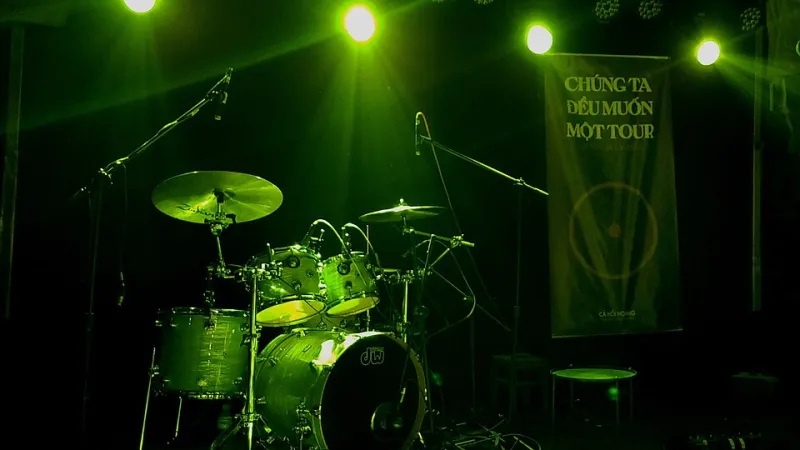
Make room for the unexpected contribution. The poet at the recording session might notice a rhythmic pattern in the room tone that the musicians have stopped hearing because they're too close to it. The filmmaker watching a live poetry reading might see a gesture that becomes the visual anchor for the whole project. Stay open to the person who doesn't know the rules of your discipline — they might be seeing something you've trained yourself not to notice.
The Amplification Effect
One thing that consistently surprises people who try cross-discipline collaboration for the first time is the audience effect. When a musician and a poet release something together, they're not just combining their work — they're combining their communities. The musician's listeners encounter the poet. The poet's readers encounter the musician. Suddenly both artists are in front of people they never would have reached working alone.
This is especially meaningful for community-based creative work. When a local filmmaker partners with a neighborhood poet to document a block's history, the resulting piece reaches both the filmmaker's audience and the poet's audience — and probably a bunch of people in that neighborhood who wouldn't have shown up for either one separately.
At Flat Bay Collective, we believe that creativity gets bigger when it gets shared — and that "shared" doesn't just mean distributed. It means made together, from the beginning, with all the productive weirdness that entails.
So if you've been thinking about reaching out to that musician you met at the last open mic, or asking the filmmaker in your building if they'd want to collaborate on something — do it. Walk into the recording session. Bring your notebook. See what happens.