Everyone's Responsible, So Nobody Is: How Collectives Are Finally Solving the Follow-Through Problem

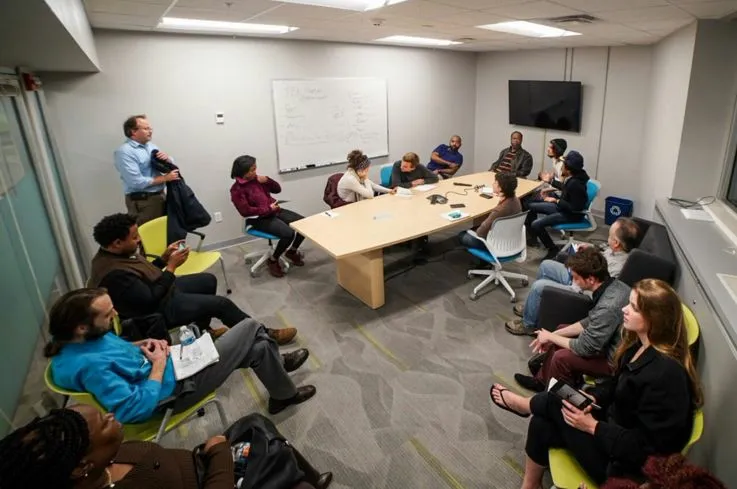
Photo: Holger Krisp, CC BY 3.0, via Wikimedia Commons
There's a particular kind of silence that settles over a group chat when a deadline has passed and nobody's done the thing. You've probably felt it. Maybe you've caused it. In a collective—where titles are fuzzy, hierarchy is a dirty word, and "we all agreed" can mean seventeen different things—that silence has a way of getting very loud, very fast.
Accountability in flat-structure creative groups is one of those problems that sounds like it should be easy. Everyone cares. Everyone showed up voluntarily. Everyone wants the project to succeed. And yet, somehow, the grant report doesn't get filed, the venue deposit sits unpaid, and by the time anyone says something out loud, the blame has already started its slow, corrosive spread.
So how do some collectives actually crack this? We dug into the practices of several community arts organizations around the country to find out what separates the groups that keep their promises from the ones that quietly dissolve after their third missed deadline.
The Problem Isn't People—It's Ambiguity
Here's the thing most collectives get wrong from the jump: they confuse shared ownership with shared responsibility for specifics. Those aren't the same thing.
Shared ownership means the vision belongs to everyone. Shared responsibility for specifics means that on Tuesday at 3pm, one particular human being is going to send that email. When you blur those two concepts together, you get what organizational researchers sometimes call "diffusion of responsibility"—the more people who are technically accountable for something, the less likely any individual is to actually do it.
A printmaking collective based out of a shared studio space in Asheville described it this way: "We used to end every meeting with 'great, we'll all handle that.' And then we'd show up the next week and nobody had handled that. It wasn't laziness—it was genuinely unclear whose job it was."
The fix? Brutally specific task ownership. Not "we'll post about the open call" but "Jamie will draft the Instagram caption by Thursday, and Renata will schedule it to go live Friday morning." Names and dates. Every single time.
Rotating Roles Without Rotating Chaos
One of the most common structural tools thriving collectives use is the rotating steward model—basically, assigning temporary point-person roles that cycle through members on a project or seasonal basis. It's not a hierarchy. Nobody's in charge of people. But someone is always in charge of the thing.
A community theater collective in Minneapolis has been running this way for years. They assign what they call "thread-holders" for each production—one person responsible for keeping a specific workstream moving. The thread-holder doesn't make unilateral decisions, but they do own the follow-up. They send the reminders. They flag when something's stalled. They're the designated nag, and it's an honor, not a punishment.
"The key was separating coordination from authority," one of their founding members explained. "The thread-holder can't tell anyone what to do. But they can tell the group 'this thing isn't moving and we need to talk about why.' That's actually more powerful."
Rotating these roles also distributes the emotional labor of keeping a collective functional—something that, left unaddressed, almost always falls on the same two or three people until those people burn out and leave.
Making Agreements That Actually Stick
Verbal consensus is lovely. It is also, functionally, meaningless when things get complicated.
Collectives that maintain strong follow-through tend to be almost obsessive about written documentation—not because they distrust each other, but because memory is unreliable and interpretation is slippery. A decision made in a lively Tuesday meeting can look completely different to five different people by Friday.
Some groups use a simple shared document where every meeting closes with a "decisions and owners" section. Others use project management tools like Notion or Trello, not for corporate efficiency reasons but because having a visible, shared record of who said they'd do what removes the fog of plausible deniability.
An arts education collective in Oakland developed what they call a "commitment check" practice: before closing any meeting, each person states out loud—not just nods along—what they're personally committing to before the next gathering. It takes maybe five extra minutes. The difference in follow-through, they say, has been dramatic.
"There's something about saying it out loud, in front of people, that makes it real in a different way," one organizer noted. "It's not about shame if you don't do it. It's about the act of making it concrete."
When Someone Drops the Ball (Because Someone Will)
Even the most functional collectives have members who miss deadlines, forget tasks, or quietly disappear during crunch time. The question isn't whether it will happen—it's whether your collective has a way to address it that doesn't turn into a referendum on someone's character.
The worst thing a collective can do, according to pretty much everyone we talked to, is let resentment build in silence and then have it explode at a moment of high stress. The second worst thing is creating a culture where accountability conversations feel like public shaming.
What works better is normalizing low-stakes check-ins before things go sideways. Some groups build a "capacity check" into their regular meetings—a quick round where members flag if they're overwhelmed or if something they committed to is at risk. It reframes dropping a task from a moral failure to a logistics problem the group can solve together.
A muralist collective in Detroit made it a rule that any member can say "I'm underwater" at any point, and the group will redistribute without judgment. "We had to build a culture where asking for help was normal," one member said. "Because in a collective, someone struggling in silence costs everyone."
Freedom and Follow-Through Aren't Actually Opposites
Here's the reframe that changes everything: accountability in a collective isn't about control. It's about respect.
When you commit to something in a collective and don't do it, you're not just dropping a task—you're transferring your work to someone else without asking. That's the thing that erodes trust. That's what turns "we're all in this together" into "some of us are carrying this while others coast."
The collectives that get this right tend to share a particular cultural belief: that being accountable to each other is an expression of the collective's values, not a compromise of them. Structure isn't the enemy of creative freedom. Vague, unspoken expectations are.
You can absolutely run a flat, nonhierarchical, deeply collaborative creative organization. Plenty of groups are doing it beautifully. But the ones doing it well have usually done the unglamorous work of figuring out exactly how decisions get made, exactly who's responsible for what, and exactly what happens when someone needs to step back.
The blank shared doc. The named task owner. The out-loud commitment. The "I'm underwater" norm.
None of it is as romantic as the idea of a collective humming along on pure shared passion. But it's what keeps the passion alive long enough to actually make something.